UT REAL Health AI Innovation Moonshot

Lighting the way during the minutes that matter most.

BEACON — Bedside Emergency AI for Care Orchestration brings clinicians, engineers, AI researchers, and startup partners together to support faster emergency decisions — and better recovery after trauma, brain injury, and stroke.

Human expertise stays in the loop.
~1M
trauma care cases used in training · 2019–2026
7
partner hospital systems building a multi-site foundation
30+
clinical + AI team members working across disciplines
2
partner startups helping move tools into real-world care

The mission

One connected system, from the first decision to the long recovery.

BEACON is building a clinician-guided AI ecosystem that spans the trauma journey, and improves patient outcomes and recovery.

01 Before arrival

Make the next decision clearer

Human-guided AI for triage, transfer, and getting patients to the right level of care faster.

02 Across the system

Build infrastructure that can scale

Shared data, validated AI pipelines, and a roadmap for consistent deployment across the state and nation.

03 Through recovery

Stay with survivors after the emergency

Patient-centered data and AI support for brain injury and stroke recovery over time. Patient-centered recovery outcomes create a learning loop that improves medical decisions.

Recovery insights improve care for both the current - and the next - patient.

Design principles

Design Principle 1

“Augment the information available to clinicians when critical decisions have to be made.”

Design Principle 2

“Improve communication for trauma and stroke patients and their care providers.”

The people

Built by a rare coalition of experts, united around better care.

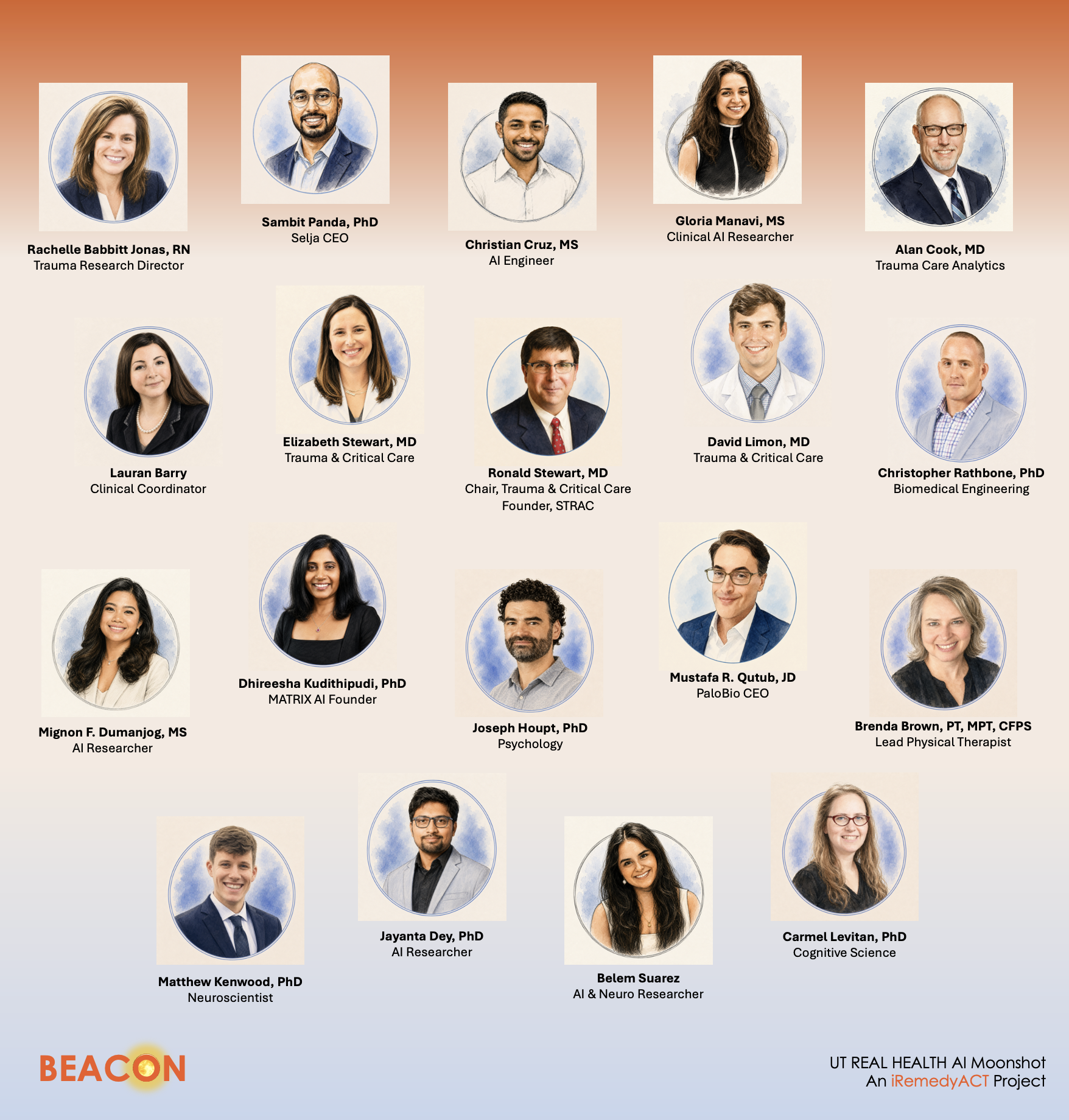
Trauma surgery, critical care, neurology, biomedical engineering, and AI — working side by side. Click a portrait to learn more.

BEACON team

Amina Ann Qutub, PhD

Project Lead · Biomedical Engineer

BEACON project lead and Burzik Professor in Engineering Design at UT San Antonio. Qutub brings biomedical engineering and AI expertise to a clinician-in-the-loop approach for emergency decision support and recovery.

Focus: AI systems · biomedical engineering · translational design

BEACON team

Brian Eastridge, MD

Co-PI · Trauma Surgeon

Professor of Surgery at UT Health San Antonio, Division Chief of Trauma and Emergency Surgery and the Jocelyn and Joe Straus Endowed Chair in Trauma Research. He brings deep expertise in trauma systems and emergency care.

Focus: Trauma systems · surgery · clinical operations

BEACON team

Mark Goldberg, MD

Co-PI · Neurologist

LeWinn Endowed Professor in Neurology at UT Health San Antonio specializing in stroke and cerebrovascular disorders, with research focused on recovery after stroke and brain injury.

Focus: Stroke · brain injury · neurologic recovery

BEACON team

Elizabeth Scherer, MD, MPH

Co-PI · Trauma & Critical Care

Assistant Professor of Trauma and Emergency Surgery and Surgical Critical Care Fellowship Director. With her deep expertise in trauma care, Scherer helps shape realistic clinical scenarios and evaluates whether AI outputs are consistent, meaningful, and actionable.

Focus: Critical care · triage · clinical validation

30+

One multidisciplinary team. Clinicians, AI researchers, engineers, psychologists, therapists, nurses, startup partners, and collaborators across the UT system and partner institutions.

Collaborating organizations

Partner institutions and affiliated collaborators.

UT San Antonio logo
TRC4 logo
The University of Texas System logo
The UTSA AI Consortium for Human Well-Being logo
STRAC logo
The University of Texas at Austin Dell Medical School logo
UTHealth Houston logo
UT Southwestern Medical Center logo
UT Tyler logo
UTMB logo
UTRGV logo
Palo Bio logo
Lone Star Stroke Research Consortium logo
Selja AI logo

Mission Stage

One mission. Six clear stages.

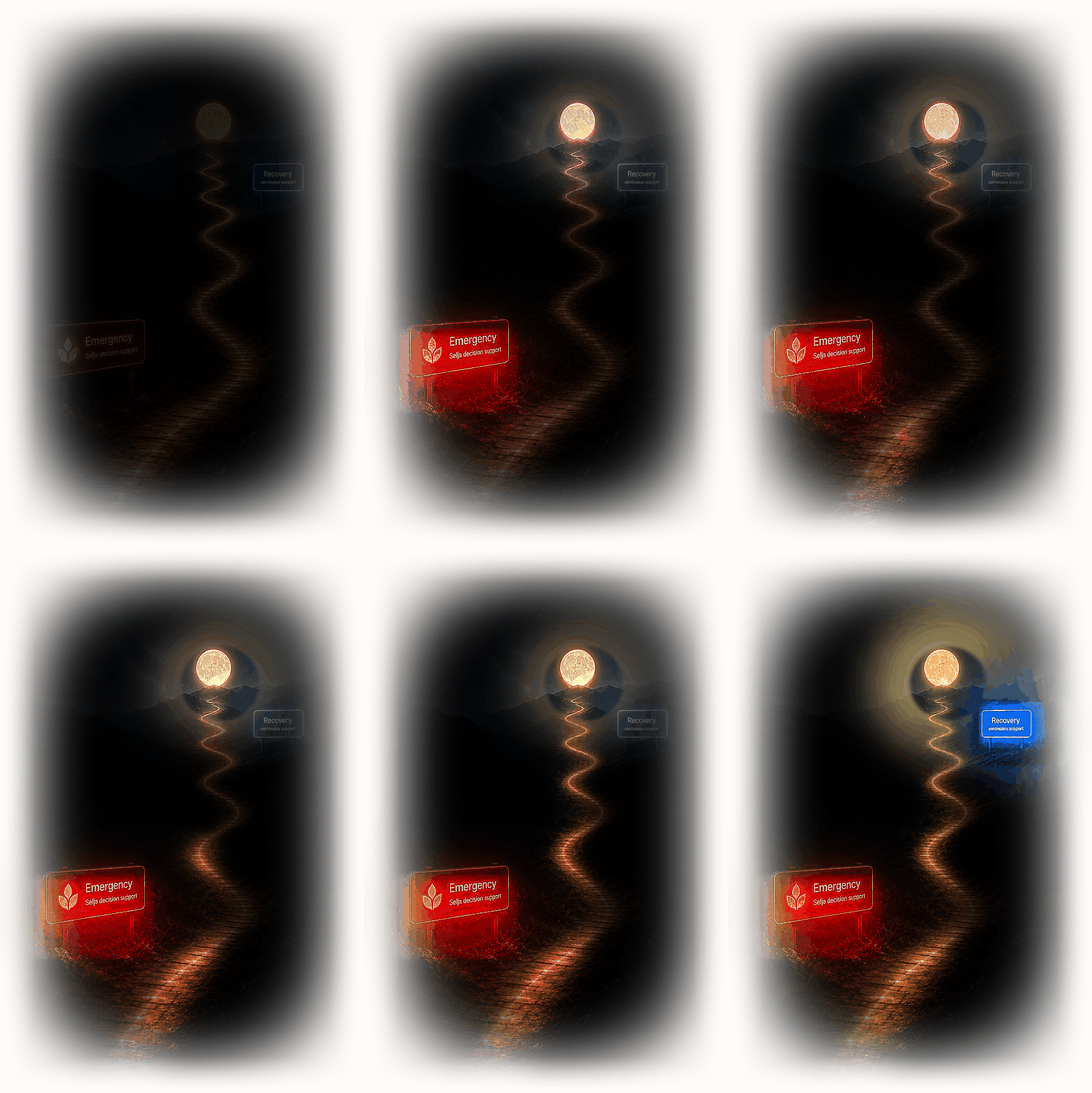
Stage 1 is complete. The next focus is deploying Selja across partner hospital sites.

Project progress 1 of 6 stages complete
  1. Mission Stage 1 Month 6

    Rapid-testing platform for testing of Selja established

    Accomplished
  2. Mission Stage 2 Months 12–18

    Selja deployed as an 'AI clinical assistant' across partner hospital sites in Texas

    Next up
  3. Mission Stage 3 Months 12–18

    Clinical AI training workshops established

    Upcoming
  4. Mission Stage 4 Months 12–18

    Post-hospitalization recovery repository established

    Upcoming
  5. Mission Stage 5 Month 18

    AI advocates developed for patients in recovery

    Upcoming
  6. Mission Stage 6 Month 18

    Patient outcomes linked to pre-hospital data and trauma care

    Upcoming

Be part of what comes next

There is a role for people who fund, build, care, and recover.

Choose a path to see how you can help BEACON move from a pilot into a durable trauma and stroke care ecosystem.

Get involved

Give to BEACON

Philanthropic and strategic support can help expand clinical validation, patient-centered recovery work, implementation research, and the shared infrastructure required for multi-site deployment.

Next step Support can expand clinical validation, survivor-centered recovery work, and the infrastructure needed for multi-site deployment. Formal giving routes can be shared through participating institutions.

Get involved

Collaborate with BEACON

BEACON is a project of the iRemedyACT Consortia, building one of the most comprehensive AI and data ecosystems for trauma care and stroke in the world. Partners welcome across the spectrum of trauma and stroke care and recovery.

Next step Potential collaborators can begin by identifying the clinical, technical, deployment, data, or survivor-centered expertise they can contribute. Partnership routes can be shared through participating institutions.

Get involved

Participate in BEACON research

BEACON Phase II is being designed to help people recovering from trauma, brain injury, or stroke, as well as caregivers. Participation opportunities will depend on study approvals, eligibility, and active recruitment at partner sites.

Next step When studies are open, participation details should come through approved research recruitment channels at participating sites. Eligibility will vary by study and site.